What Music Should Gyms Play?
Pop, hip-hop, rock, and electronic dance music can all work well in the right zone, with the best gym music usually sitting at 120 to 140 BPM. Classical, opera, folk, and ambient nature tracks rarely work outside yoga, stretch, or recovery areas. Lyrics also matter. Every song should fit your gym’s brand, audience, and time of day before it plays.
Most gym owners know music matters. Fewer know exactly why the wrong playlist can drain the energy from a room before a single member complains. If you are deciding what music to play in a gym, start with tempo. Then adjust by zone, audience, volume, and brand.
Custom Channels curates music for gyms and fitness facilities across the country. These recommendations come from what we see working on real gym floors every day. This guide covers what to play, what to avoid, how loud to go, and how to handle explicit music in a gym.
Why Does BPM Matter More Than Genre?
Before you think about genre, think about tempo.
One study published in the National Library of Medicine tested high-tempo music at 130 BPM. People listening to that music exercised 10.7% longer than people who exercised without music. That does not mean every gym song needs to sit at 130 BPM, but it shows how strongly tempo can affect exercise intensity.
The National Center for Health Research also gives useful BPM ranges. Cycling often works best around 125 to 140 BPM. Treadmill work often fits 123 to 131 BPM. The idea is simple. People tend to move with the beat. A song can sound like a gym song, but if it sits at 85 BPM, it may feel slow on the floor even if nobody can explain why.
That is why Custom Channels curators build gym playlists around tempo first, then genre.
The Right Music for Every Zone in Your Gym
A weight room and a yoga studio need different music. A lobby and a locker room do too.
The goal is not to find one perfect playlist for the whole building. The goal is to match the sound to the space.
| Zone | Recommended Genres | BPM Range | Custom Channels Playlist | Avoid |
|---|---|---|---|---|
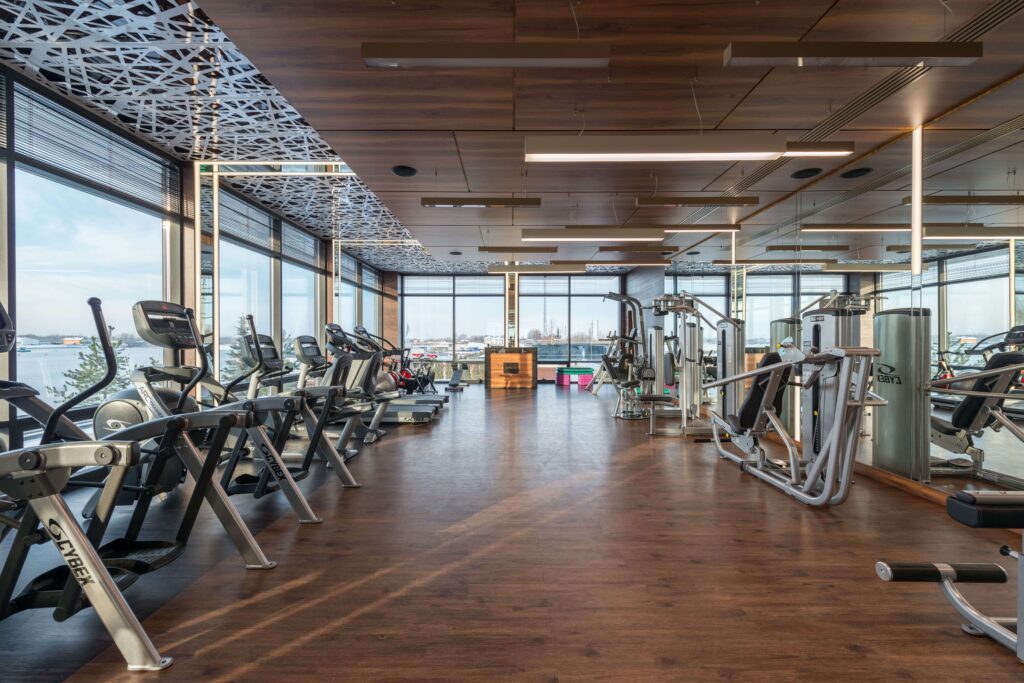
| Weight room | Hip-hop, hard rock, EDM, classic rock | 130 to 150 | Rock Workout, Hard Classic Rock, Certified Hip Hop, Sports Bar | Folk, ballads, classical |
| Cardio floor | Pop, dance, EDM, upbeat R&B | 120 to 140 | High Energy Electro-Pop, Pop Drop, Chart Toppers, Energy | Slow R&B, country ballads |
| Group fitness or HIIT | EDM, hip-hop, pop remixes, high-energy rock | 128 to 145 | Energy, Pop Drop, High Energy Electro-Pop, Power Punk | Anything below 110 BPM |
| Yoga, stretch, or recovery | Acoustic, ambient, light instrumental | 60 to 90 | Spa Luna, Spa Sol, Spa Guitar, Spa Nature, Lo-fi Instrumentals | Heavy metal, aggressive hip-hop, EDM |
| Lobby or reception | Upbeat pop, indie, contemporary | 100 to 120 | Sunny, Bright Mix, Today’s Pop, Sports Bar | Explicit hip-hop, aggressive rock |
| Locker rooms | Chill pop, soft R&B, acoustic | 80 to 110 | Chill Pop, Vibe, Over Easy, Afterglow | Loud EDM, aggressive genres |
Every playlist listed above is available on the Core and Control plans at Custom Channels. Our music team builds and reviews those playlists for business environments, not personal headphones. Start a free trial, and you can start listening right away.
A regional gym chain with dozens of locations across Texas plays different playlists at each facility and across all zones. The weight room does not sound like the lobby. The lobby does not sound like the locker room. That is the point. One note: instructor-led group fitness classes can require separate music licensing from standard background music. If your gym runs exercise classes, confirm that use case before relying on any music service.
What Songs Should Gyms Never Play?
Some genres do not belong in most gym environments. Some songs also make sense on paper and fail the second they hit the speakers.
Here are the main playlist styles to avoid in workout areas:
- Classical and orchestral: The tempo, energy, and brand fit rarely match a main gym floor. Save it for the spa.
- Opera: Same problem as classical, but usually louder and more jarring.
- Folk and acoustic singer-songwriter: Great music, wrong room. The energy drops fast.
- Nature soundscapes: Birds, rain, and ocean waves belong in recovery rooms, not next to a squat rack. We built Spa Nature for exactly that purpose.
- Extremely slow ballads: A 65 BPM power ballad on a cardio floor feels like someone pulled the emergency brake.
- Spoken word and podcasts: They distract more than they energize, and yes, this happens more than you would think.
And then there are the specific songs that should stay far away from the gym floor:
- “Everybody Hurts” by R.E.M. 90 BPM, vibe: giving up.
- “Sound of Silence” by Simon and Garfunkel. The title says enough.
- “My Heart Will Go On” by Celine Dion. Unless your treadmill section is also a cruise ship.
- “Creep” by Radiohead. 92 BPM, vibe: watching rain from a window.
- “How Soon Is Now” by The Smiths. The song starts with “I am human, and I need to be loved.” Not a lifting anthem.
- “Candle in the Wind” by Elton John. No.
- “Yesterday” by The Beatles. Timeless song, terrible gym song.
- “Another One Bites the Dust” by Queen. Great BPM, unfortunate gym-floor imagery.
Explicit Lyrics: Decide Before Someone Decides for You
Explicit music in a gym is not always wrong. In some strength, boxing, and performance-focused facilities, harder hip-hop and rap fit the culture. The problem starts when nobody makes a real decision. Then the playlist decides for you.
Here is the simple rule:
If your gym is family-oriented, has youth programming, or serves a broad membership mix, filter explicit content during those hours. If your facility is strength and performance focused and members expect harder hip-hop and rap, that music can fit the room. Either way, make the choice on purpose.
Custom Channels creates extra-clean edits for Today’s Hip Hop, R&B, and Certified Hip Hop because even radio edits can still be too suggestive for some businesses. We recommend listening at home or trying a free trial to make sure the mix is right for your space.
That kind of transparency matters. A basic explicit-content toggle that our competition uses does not always solve the real problem. Gym owners need to know whether the music fits the audience, not just whether a radio edit removed one word.
Custom Channels uses only clean versions of tracks by default, with human review behind every song in our catalog. That review helps reduce the chance that suggestive lyrics slip through a standard radio edit and land in the wrong environment.
Gym Music Volume Rules: How Loud Should It Be?
The Volume Problem
The Washington Post reported that some gyms regularly operate at 99 decibels, which is comparable to a motorcycle engine. OSHA recommends limiting exposure to 85 decibels for extended periods. At 99 decibels, hearing damage can occur in less than 30 minutes. Staff members who hear loud music for a full shift face more risk than members who stay for one workout.
Turning up the music feels natural. Loud music can raise energy, support movement, and cover background noise. Still, every fitness center needs a volume ceiling. Too much volume creates liability, staff health concerns, and a member experience that can feel aggressive instead of motivating.
As a general guide, keep the weight room around 75 to 80 decibels. Lobby and locker room music usually works better around 65 to 70 decibels. Yoga and recovery zones should be lower. A centralized music system helps operators manage sound levels by zone. It also helps prevent staff from raising music volume beyond safe noise levels during a busy shift.
Can Multi-Location Gyms Manage Music Across Every Facility?
One of the most common questions we hear from multi-location operators is how to keep music consistent without making it identical everywhere.
The answer is giving each location the right amount of flexibility within a system that stays clean and licensed no matter what anyone plays.
Here is how one regional gym chain with dozens of Texas locations handles it using the Custom Channels Control plan. Each location has its own login. Some managers build playlists entirely from scratch, selecting songs one by one until they have 400 or 500 tracks that fit their specific crowd. Others blend pre-curated Custom Channels playlists into a custom mix, something like 40% Hard Classic Rock, 39% Certified Hip Hop, and 20% Energy. Others build multiple playlists and schedule them by time of day, switching the sound as the crowd shifts from an early morning rush to an afternoon crowd to an evening session.
Every option stays within the same guardrails. No explicit content, unlicensed tracks, intros, outros, or ad breaks. The owner does not have to police what plays at each location because the system handles that automatically.
That is the difference between giving employees a Spotify login and giving them a professional music tool. One creates risk. The other creates a brand.
One More Thing: The Music Needs to Be Licensed
Everything above assumes the music played in your gym is licensed for commercial use. Spotify, Apple Music, and YouTube do not license personal accounts for business use. A personal account running through a Bluetooth speaker can create copyright risk no matter how good the playlist sounds.
A licensed commercial music service handles performing rights organization coverage for ASCAP, BMI, SESAC, and GMR. That gives your gym a legal music source instead of a personal streaming workaround.
For the full picture, read our guide to music licensing for gyms. If you are still using a personal streaming app, our post on Spotify alternatives for gyms explains what to do next.
Getting Your Gym’s Sound Right
The best gym playlists are not random. They come from clear decisions about tempo, genre, zone, volume, and lyric standards.
Custom Channels curates music specifically for fitness environments, with real human review behind every track. Every playlist style you need for every zone in your facility is available on Core and Control plans. You can also visit our music for gyms page to see how the platform works for fitness facilities.
See Custom Channels pricing and start a free trial today.
Frequently Asked Questions
What is the best BPM for gym music?
Most gym zones work best with music between 120 and 140 BPM. Cardio floors and group fitness classes often sit toward the higher end of that range. Lobbies and locker rooms usually work better around 100 to 120 BPM. Yoga and recovery areas need slower music, usually around 60 to 90 BPM.
What music genres should a gym avoid?
Most gyms should avoid classical, opera, folk, acoustic singer-songwriter, ambient nature soundscapes, and extremely slow ballads in main workout areas. Those playlist styles usually create a tempo and energy mismatch. Save them for recovery rooms, spas, or cool-down areas where slower music makes sense.
Can a gym play explicit music?
It depends on the facility. Strength and performance-focused gyms may choose harder hip-hop and rap because members expect that energy. Family-oriented gyms, youth programs, and broad-membership facilities should usually filter explicit content, especially during daytime hours. The key is to make the decision before a song creates a complaint.
How loud should gym music be?
A general rule is to keep the weight room around 75 to 80 decibels and lobbies or locker rooms closer to 65 to 70 decibels. The Washington Post reported that some gyms run as loud as 99 decibels, which raises concerns about noise-induced hearing loss. Staff members hear the music all day, so volume is a health issue, not just a vibe issue.
Do gyms need licensed music?
Yes. Music played publicly in a commercial fitness facility needs proper licensing through performing rights organizations. Spotify, Apple Music, and YouTube do not license personal accounts for business use, even with a paid subscription. A commercial music service like Custom Channels handles ASCAP, BMI, SESAC, and GMR coverage. For more detail, see the full guide on music licensing for gyms.
Written by Mark Willett, Director of Music Strategy, Custom Channels