Music Licensing for Instructor-Led Fitness Classes
Can you use Custom Channels for instructor-led fitness classes if your gym already has ASCAP and BMI licenses? Yes. You can use Custom Channels to deliver the music. The important distinction is that instructors can choose a playlist, but they cannot control the exact song-by-song playback order.
This question recently came up from a CrossFit affiliate owner who runs instructor-led group classes. They were already a step ahead because the gym maintains its own ASCAP and BMI licenses directly. What they still needed was the right way to actually deliver the music during classes.
That is where the distinction matters. A public performance license and a music streaming service solve two different parts of the problem. Having direct PRO licenses does not automatically make a personal Spotify account appropriate for commercial use. For this gym, the answer was to maintain the direct licenses needed for its class setup and use Custom Channels for the music playback.
What Does Non-Interactive Music Mean?
Custom Channels is a non-interactive music service for gyms and other businesses. You build or choose a playlist, and the service determines the playback order. An instructor can walk into class, select the playlist they want, press play, and start teaching. What they cannot do is manually control every song that comes next.
That is the biggest practical difference between a consumer streaming service and a commercial music service built for business use. Spotify gives the listener control over playback order (but it is illegal to use in a business setting). A music-for-business service gives you control over the overall music experience without letting you queue every song in a specific sequence.
What Would This Look Like at a CrossFit Gym?
Let’s say you have 10 instructors, and each one already has Spotify playlists they use for different workouts. Maybe they have one for strength days, one for conditioning, and one for Saturday classes. You don’t have to rebuild those playlists from scratch when you move to Custom Channels.
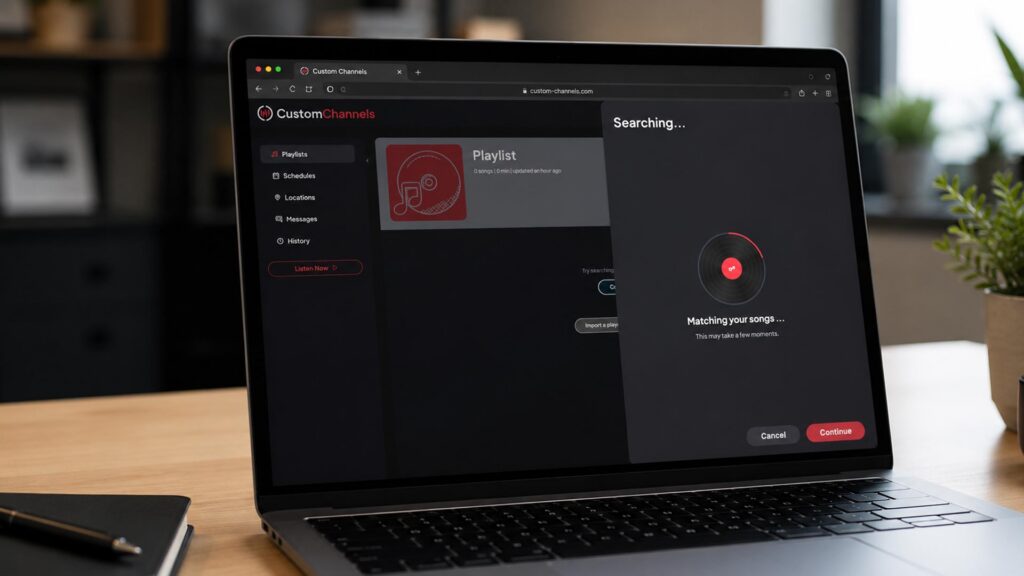
If an instructor has a 40-song Spotify playlist they love, you can import it into Custom Channels. We match those songs with the clean, commercially licensed versions in our music-for-business library. The playlist then lives in your Custom Channels dashboard, where instructors can add or remove songs and keep it updated over time.
Before class, the coach chooses that playlist and hits play. The only difference is that they can’t control the exact order of those 40 songs.
Can Gyms Use Spotify With ASCAP and BMI?
Direct ASCAP and BMI licenses do not turn a personal Spotify account into a business music service. A gym may have a public performance license from one or more performing rights organizations and still need an appropriate commercial playback service.
The PRO licenses address public performance rights for the music they represent. The playback service handles how the music actually reaches your speakers. For a gym owner, getting one side right does not automatically solve the other. We cover that distinction in more detail in our guide to legal Spotify alternatives for gyms.
What About Instructor-Led Classes?
Music licensing for instructor-led fitness classes can require a different setup than background music playing on the main gym floor. That is exactly why this CrossFit owner asked us the question in the first place.
If you are simply playing background music throughout a fitness facility, a licensed music-for-business service can handle the music delivery and the licensing included within that service. Instructor-led classes can introduce additional public performance licensing considerations based on how the music is being used. That may mean maintaining direct licenses with the relevant performing rights organizations in addition to using a commercial music service for playback.
ASCAP and BMI are two of the major PROs, but they are not the entire licensing landscape. Depending on the music you use and your specific setup, organizations such as SESAC and GMR may also be part of the picture. We break those organizations down separately in our gym owner’s guide to ASCAP, BMI, SESAC, and GMR.
The right answer depends on how your gym actually uses music. That is why we would rather have a five-minute conversation about how your classes work than give every gym owner the same generic licensing answer.
How Does This Work Across Multiple Instructors and Locations?
This is where a music-for-business platform becomes especially useful. Maybe you operate five gyms, and each gym has a main workout floor, lobby, locker rooms, and several rooms used for group fitness classes. Those areas could have the same music throughout or different music in each area.
You can create separate music zones and give each area the right sound. The main gym floor can have one playlist, the lobby can have another, and a class space can have playlists built around what the instructors actually want to teach with. If you want a deeper look at setting up different spaces this way, our guide to multi-zone music for gyms and fitness facilities walks through it in detail.
You can also control what each instructor sees. If a coach only needs access to five playlists, they do not need to scroll through your entire music library. They can walk into the room, choose the music they need, and teach.
Could you imagine an instructor walking into class, tapping the mix they want on a touchscreen, and having that music play only in that room? That’s the kind of setup our partner Bluesound Professional can help create. Their commercial audio systems work with Custom Channels to give instructors simple control over the music in each space, without having to rely on a personal phone.
For operators with several locations, you also get visibility from a single dashboard. You can see which locations are online, what music is playing, and how different zones are set up. That solves a much bigger operational problem than simply putting music on a speaker.
Gym Music Licensing for Group Fitness Classes Does Not Have to Be Complicated
There are many acronyms in music licensing. ASCAP, BMI, SESAC, GMR, PRO licenses, public performance rights. It gets complicated quickly if you try to solve the entire music industry at once.
For a gym owner, the starting point is much simpler:
- How are you actually using music?
- Are you playing background music on the gym floor?
- Are instructors running group fitness classes?
- Do those instructors bring their own playlists?
- Do they need to choose a playlist, or do they need exact song-by-song control?
- Do you already have direct licenses from performing rights organizations?
Once we know those answers, we can tell you where Custom Channels fits. For the CrossFit gym that brought us this question, the answer was straightforward. They could maintain the direct licenses needed for their class environment and use Custom Channels as the non-interactive commercial music delivery service.
Their instructors could still work from the playlists they already loved and stay legally compliant. The only difference is that they could not control the exact playback order like Spotify. That is the line to understand.
If your fitness studio, CrossFit affiliate, or gym has the same question, tell us how you currently use music. We will help you work through the setup and explain where Custom Channels fits.
Frequently Asked Questions
Can I use Custom Channels if my gym already has ASCAP and BMI licenses?
Yes. Your gym can use Custom Channels as the music delivery platform even if you already maintain your own PRO licenses.
Can fitness instructors choose their own playlists?
Yes. Instructors can choose from playlists available in Custom Channels, including playlists imported from Spotify.
Can instructors control the exact song order?
No. Custom Channels is a non-interactive music service, so instructors can select a playlist but cannot control the exact song-by-song playback order.
Can I import a Spotify playlist into Custom Channels?
Yes. Spotify playlists can be imported into Custom Channels, where we match available songs from our commercially licensed music library and use appropriate clean versions where available.
Can I use Spotify in my gym if I already pay ASCAP and BMI?
No. Paying PRO licenses does not change Spotify’s terms of use. A personal Spotify account is not licensed as a commercial music delivery service for a business.
Do instructor-led fitness classes need additional music licensing?
Yes, they can. Music for instructor-led fitness classes may have different licensing requirements depending on how the music is used. If your gym runs group classes, review your setup with the appropriate licensing organizations and your music provider.
Written by Jeremy Bookman, Director of Sales at Custom Channels.