Do Grocery Stores Need a Music License?
Yes- every grocery store in the United States that plays music in public must have performance licenses. Grocery stores must license to legally play music in-store – direct licensing runs $3,000–$5,800/year per store. These licenses come from major performing rights organizations, including ASCAP, BMI, SESAC, and GMR.
That is not a suggestion. It is federal copyright law. Music licensing for grocery stores may seem complicated. But the rule is simple.
If people can hear music, you need public performance licenses. It does not matter whether it comes from an overhead system, a tablet, or a phone connected to Bluetooth. Once music is playing in a commercial space, the licensing requirement applies.
Most grocery operators never think about this until a letter arrives. We have handled licensed music for grocery operators for decades, including more than ten years working with Whole Foods Market.
A lot of what follows comes from doing this at real scale.
Why Do Grocery Stores Need Music Licenses?
The rules for background music in grocery stores are the same whether the music comes from overhead speakers, a tablet, or a phone. Any music played publicly in a business is considered a public performance. That applies to every song that plays overhead in your store, whether it is a slow Tuesday morning or the Saturday before Thanksgiving.
According to the Food Marketing Institute, the average supermarket in the United States is 42,272 square feet. With dozens of speakers running eight to sixteen hours a day, seven days a week, the exposure is significant. So is the liability if the music is not properly licensed.
Statutory damages for willful copyright infringement can reach $150,000 per song under federal law. Grocery stores are not exempt.
If you are playing Spotify, Apple Music, or YouTube overhead, you are not licensed for business use. Those platforms say so explicitly in their own terms of service. Public performance licensing is a separate requirement that consumer streaming services do not cover.
Four performing rights organizations matter most in the U.S.: ASCAP, BMI, SESAC, and GMR. Together, they represent most of the commercial music a grocery store would want to play.
The Four PROs Every Grocery Store Needs to Know
Each PRO represents a different catalog of songwriters and publishers. One music license does not cover every song. Songs are often co-written by people represented by different PROs, so leaving one out could leave gaps in your coverage.
Here is how they break down and what they may cost for a grocery store of average size:
| PRO | Catalog Size | Key Artists | Est. Annual Cost Per Store | In Custom Channels |
|---|---|---|---|---|
| ASCAP | 20-plus million works | Beyoncé, Katy Perry, Justin Timberlake | $800 to $1,500 | Yes |
| BMI | 22-plus million works | Taylor Swift, Post Malone, Lady Gaga | $800 to $1,500 | Yes |
| SESAC | Invitation-only, significant catalog | Bob Dylan, Adele, Neil Diamond | $900 to $1,800 | Yes |
| GMR | 45,000-plus works, high-value roster | Drake, Bruno Mars, Bruce Springsteen | $500 to $1,000 | Yes |
| Total direct | $3,000 to $5,800 per year | All four bundled |
Cost estimates are based on publicly available PRO rate information and average grocery store square footage. Actual rates vary based on factors such as square footage, number of speakers, and hours of operation.
One thing worth noting: not every business music service covers all four licensing agencies. Soundtrack states on its licensing page that SESAC is not available on its U.S. plans. Custom Channels covers all four PROs with no gaps. If your stores are in Canada, we also cover SOCAN and Re:Sound.
For more on how GMR has pursued businesses that were not properly licensed, see our article on Global Music Rights.
Why Should Grocery Stores Not License Directly?
You can contact each PRO yourself, provide your square footage, get a quote, and pay. If you do that, you can technically handle the licensing directly, but the numbers add up fast.
For a single average-sized grocery store, licensing all four PROs directly can cost an estimated $3,000 to $5,800 per year. For operators with multiple locations, the bigger challenge is keeping every store properly licensed while also managing what or message plays, when, and whether the system is working.
Four separate contracts, renewal cycles, and compliance relationships. Which means four separate conversations every time something changes.
By comparison, the Custom Channels Control plan is $35 per location per month, or $420 per year, with all four PROs included. No separate PRO contracts or renewal cycles to manage.
Then there is the delivery problem. Even if you pay the PROs directly, you still need a way to play the music. Spotify was not built to manage music across a grocery business. Explicit songs sneak in. Suggestive lyrics can slip past a clean filter. Radio edits that would pass at home may not belong in a store with families shopping on a Saturday afternoon.
If you have twenty stores, the only way to know what any of them is playing may be to walk in and listen. In that scenario, you have zero visibility, control, or consistency. A business music service solves that problem by handling the licensing, delivery, curation, and multi-location management in one place.
What Did Custom Channels Do for Whole Foods?
Our first and biggest client for many years was Whole Foods Market. We started with the original store on Pearl Street in Boulder, and by 2019 we were streaming music to 450 locations across the United States and the UK.
It started simple. Whole Foods wanted a branded music experience that felt like Whole Foods. The goal was a shopping experience that felt intentional from the moment someone walked in the door.
As Whole Foods grew, the program grew with it. We built regional playlists for different store concepts and geographies. Hawaii locations got an island-influenced playlist. Colorado stores near KBCO, the legendary Denver radio station, got a playlist that matched that local taste. UK stores got their own program. The 365 Market concept had its own distinct identity.
Each Whole Foods region could see what its stores were playing, confirm locations were online, and manage music without affecting other regions.
That is what Curate is built for. A dedicated music programmer builds and updates playlists specifically for your brand, whether you have five locations or five hundred.
Beyond Licensing: What a Music for Business Service Actually Delivers
Licensing is just the starting point. It gets you compliant, but it does not solve the day-to-day music experience. At Custom Channels, a human reviews every song before we add it to our music library. If it needs a special edit for business, it gets one.
A radio edit can still include suggestive content that does not belong in a grocery store at ten in the morning while families are shopping. That distinction matters for both the shopping experience and your brand. We build our playlists with large rotations so they stay fresh. A song you hear Monday afternoon is unlikely to come back again until later in the week.
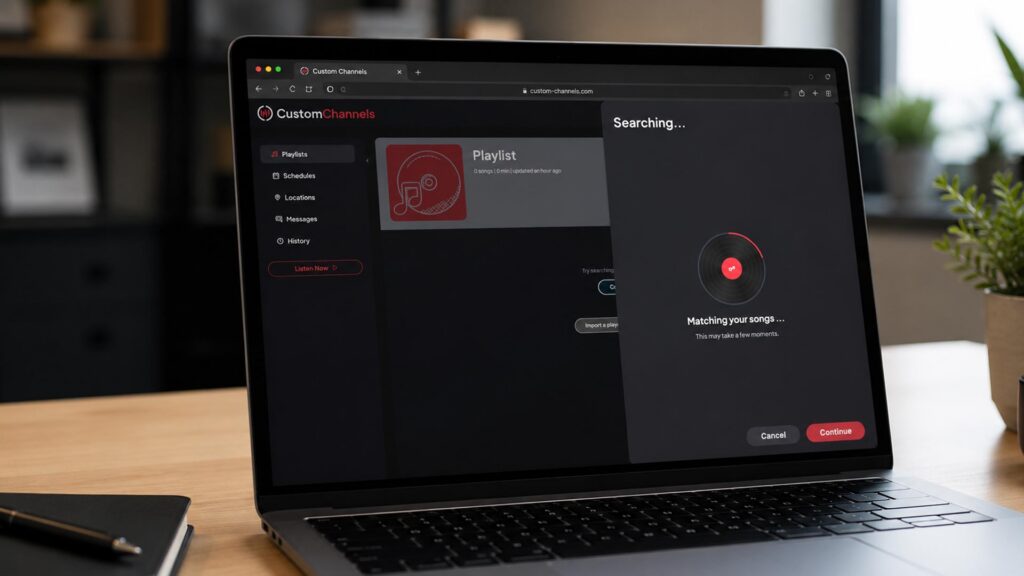
These are details a grocery store owner may never think to ask about until an employee says they have heard the same song three times that day. Our dashboard gives grocery chains visibility across every store from a single dashboard. Operators can see what is playing, check recent history, spot an offline device, and see which messages have run.
Then there is audio messaging. Overhead announcements between songs. In-store promotions. Employee recognition. Seasonal campaigns. Daily specials. Those messages can run automatically in the music stream so no one has to remember to push a button.
This is what licensed music for business actually looks like when it is working.
Getting Your Grocery Store Licensed and Sounding Great
The simplest way to get compliant and stay compliant is to use a music for business service that handles the PRO relationships for you. You stop managing licensing, stop worrying about what is playing at each location, and can focus on building an in-store experience your customers actually notice.
Core covers stores that want great out-of-the-box playlists at $25 per location per month. More than 150 pre-curated playlists, licensed and clean, ready to play.
Control adds playlist blending, Spotify import, scheduling, and multi-location management at $35 per location per month. This is where most growing grocery chains land.
Curate adds a dedicated music programmer who builds and evolves playlists specifically for your brand.
Visit our music for grocery stores page to learn more about how Custom Channels works for supermarkets and grocery chains.
You can also see Custom Channels pricing and start a free trial.
Frequently Asked Questions
Do grocery stores need a music license?
Yes. Music played for customers or staff in a grocery store counts as a public performance and needs the proper licensing from organizations including ASCAP, BMI, SESAC, and GMR.
Can a grocery store play Spotify or Apple Music?
No. A personal streaming subscription does not give a grocery store the rights needed to play music commercially. Consumer streaming services are licensed for personal use, not business use.
Which music licenses does a grocery store need?
This depends on the songs a grocery store wants to play. In the United States, grocery operators generally need coverage for ASCAP, BMI, SESAC, and GMR to play a broad commercial music catalog. In Canada, SOCAN and Re:Sound also come into the picture. A business music service like Custom Channels handles that coverage in a single subscription.
Can one music service cover multiple grocery locations?
Yes. A business music service can handle licensing and music management across multiple locations from one account. Custom Channels gives operators a single dashboard to manage playlists, see every store, and confirm locations are online.
Written by Mark Willett, Director of Music Strategy, Custom Channels